You’ve tried everything that’s supposed to work — and somehow, every single month, the same spot on your jawline breaks out like clockwork. If that sounds familiar, your skincare routine probably isn’t the problem. Your hormones might be running the show, and treating hormonal acne like regular acne is exactly why “nothing works.”
(This post contains affiliate links — we may earn a commission if you buy through them, at no extra cost to you.)
Key Takeaway
Hormonal acne shows a recognizable pattern — jawline location, cyclical timing, deep cystic texture — and needs a different approach than standard breakout treatments.
The Pattern That Gives It Away
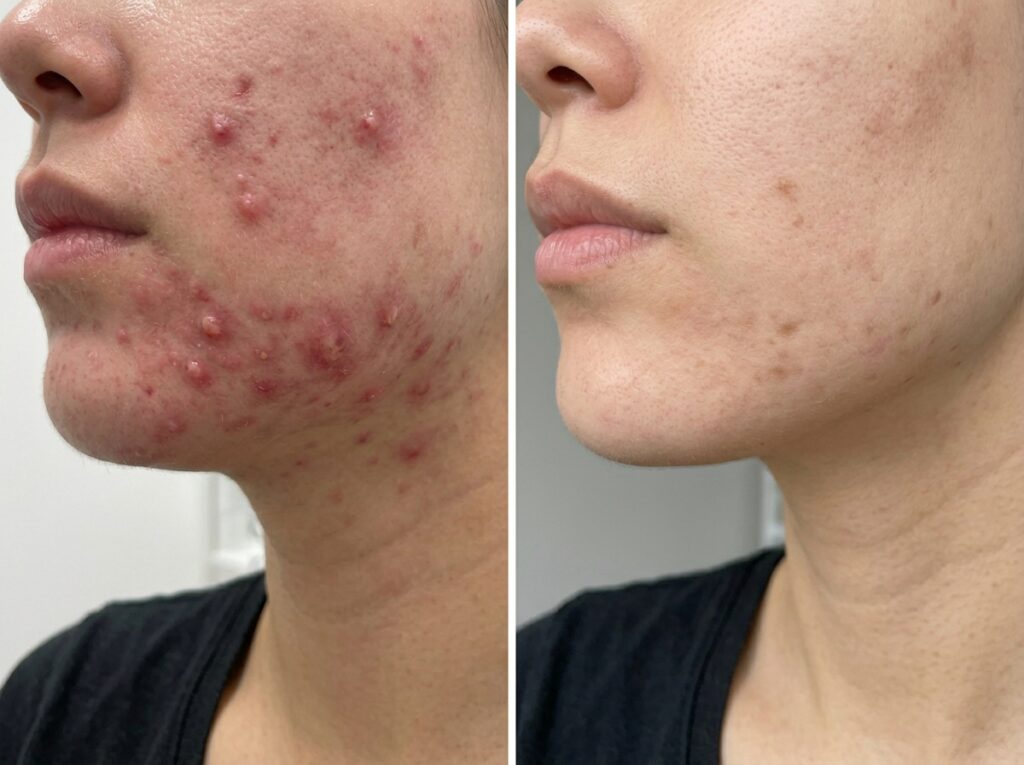
Hormonal acne has a recognizable signature most other acne doesn’t:
- Location: jawline, chin, and lower cheeks — rarely the forehead or nose
- Timing: flares in a predictable cycle, often the week before a menstrual period, or tied to other hormonal shifts (starting/stopping birth control, perimenopause, PCOS)
- Texture: deeper, tender, cystic bumps rather than surface-level whiteheads
- Resistance: doesn’t respond well to standard salicylic acid or benzoyl peroxide routines that work fine for other acne types
If two or more of these match what you’re seeing, hormones are likely a meaningful factor — even if your skin isn’t acne-prone the rest of the month.
What’s Actually Happening Underneath
Androgens (a hormone group present in everyone, just at different levels) stimulate oil glands to produce more sebum. Right before menstruation, estrogen drops and androgen activity becomes relatively more dominant, which is why breakouts often spike in that window specifically. The same mechanism is why PCOS, certain birth control changes, and perimenopause can all trigger similar patterns — they all shift this hormonal balance.
What Actually Helps
Topical treatment still matters, but expect it to do less alone. Adapalene (a retinoid) is genuinely useful here because it addresses the clogged-pore mechanism, even though it doesn’t touch hormones directly. Use it consistently, not just during flare weeks — hormonal acne responds better to steady, ongoing treatment than to reactive spot-treating.
Niacinamide can help with the inflammation side. It won’t stop hormonal triggers, but it reduces redness and calms the deeper, tender bumps that are characteristic of this acne type.
Track your cycle alongside your skin. Even a simple notes-app log of breakout timing versus cycle day can reveal the pattern clearly within 2-3 months — useful both for your own understanding and if you eventually see a dermatologist.
When This Becomes a Dermatologist Conversation
If breakouts are consistently cystic, painful, leaving marks or scarring, or you suspect an underlying condition like PCOS (especially alongside irregular periods, excess hair growth, or other symptoms), this moves beyond what skincare alone can address. Dermatologists can offer options — spironolactone, certain birth control formulations, or prescription retinoids — that work with the hormonal mechanism directly rather than around it.
What Won’t Help (Stop Wasting Money Here)
- Stronger over-the-counter acne washes — hormonal acne isn’t primarily a surface-cleanliness issue
- Switching skincare brands repeatedly — if the pattern is hormonal, the brand isn’t the variable that matters
- Extreme dietary elimination without tracking — some people do see a connection with dairy or high-glycemic foods, but cutting everything at once makes it impossible to identify what (if anything) actually helped
Frequently Asked Questions
How do I know if it’s hormonal acne or just regular acne?
Look at location and timing together — hormonal acne clusters on the jawline and chin and flares on a predictable monthly cycle. Regular acne tends to be more spread out and isn’t tied to a cycle pattern.
Will birth control fix hormonal acne?
For some people, yes — certain formulations are specifically prescribed for this reason. It’s a conversation to have with a doctor, not something to self-start based on a guess.
Is hormonal acne permanent?
Not necessarily. It often improves significantly with consistent treatment and, for some, naturally shifts as hormone levels change over time (such as after perimenopause stabilizes).
The One Thing to Remember
Hormonal acne isn’t a sign that your skincare routine has failed — it’s a different mechanism that needs a different, more patient approach: consistent topical treatment, cycle tracking, and recognizing when it’s time to bring in a dermatologist rather than trying yet another cleanser.
For the full breakdown of how to layer actives like adapalene and niacinamide correctly, see [The Acne Treatment Hierarchy].
Related reading: If hormonal breakouts have you confused about where to start, The Acne Treatment Hierarchy walks through what to try first. And if your skin runs oily on top of breaking out, our oily skin guide can help balance both.